

Have you ever done a low carb diet? Keto, Atkins, South Beach? I’m sure there are hundreds more. I am also sure that 99% of the people reading this have attempted a low carb diet at some point in their life. Now, I am not knocking a low carb diet for losing weight -lots of people have success losing weight by cutting out carbs. However, many people also gain the weight back very quickly once they re-introduce carbs back into their lives and I don’t know many people with enough willpower to give up bread and pasta for the rest of their lives. What a sad life that would be…
Personally, I do not do well with someone telling me I can’t have something. Maybe this traces back to my bratty teenage years when my mom told me I couldn’t go to the hotel party my best friend was having for her 18th birthday. Who knows? But I do know that the moment someone tells me I can’t have something, it literally becomes all I think about. This doesn’t just apply to food. A boy who didn’t like me back? A friend’s party I wasn’t invited to? This is also why I failed at quitting alcohol so many times. It’s like the forbidden fruit.
Most of my weight loss attempts throughout the years have involved an elimination type of diet. I had MANY attempts at removing carbs from my diet. I gave up meat and dairy. I gave up only meat. I gave up only dairy. I gave up sugar. I eliminated alcohol. I did Whole30 and eliminated sugar, alcohol, grains, legumes, soy, dairy, and processed foods all at the same time. All these attempts ended the same way. I was successful for X amount of time, sometimes losing weight and sometimes not, but every time I ended up bingeing on whatever food group I had eliminated when I decided I was done with the diet. And not just for one meal, but for days or even weeks at a time. This cycle is unhealthy in so many ways – physically, emotionally, and mentally. I always ended up right where I started and then hated myself for being so “weak.” I knew there had to be a better way but didn’t know what it was. I thought I was the problem.
I had heard of people counting macros and saw lots of fitness influencers talking about counting macros on social media, but in my mind, I always thought of that as an “advanced technique” for people who really had their shit together. People who did CrossFit or lifted heavy weights or ran marathons or were personal trainers. I couldn’t even go a week without a slice of bread so how was I supposed to learn to track my macros and then stick to it? It seemed too hard. Too hard to calculate, too hard to track, too hard to stick to consistently. I never even attempted to do research on the topic because I was so intimidated. Instead, if I heard someone say something about tracking macros, my brain immediately tuned out. But I was wrong about ALL OF THOSE THINGS.
In February of 2023, I saw one of those ads on Facebook where a woman who had the type of body I wanted (slim but toned and muscular) was talking about how she spent so long eating as little as 1000 calories a day and it wasn’t until she upped her calorie intake that she started to see the results she wanted. She didn’t cut out any food groups, she ate more food than she could have ever imagined and was seeing all the results she was hoping for. For some reason, even though I am typically very annoyed by ads on social media, I clicked on the calculator included in the ad to see how many calories I should be eating. This led me to a whole conversation through FB messenger with my now online fitness coaching group, DLDNation. Not only did they calculate the calories I should be eating to maintain my current weight, but they also helped me calculate how many calories I should be eating per day in order to lose weight at a healthy pace AND helped me calculate my macros with that calorie breakdown based on a few other factors. I have been counting macros ever since and I can honestly say I have never had a healthier relationship with food.

So, what are macros and why would I want to track them?
Macro is short for macronutrient. These are the three categories of nutrients you eat the most of and that provide you with most of your energy. The three macronutrients are protein, carbohydrates, and fats. Just about everything we eat is a protein, carbohydrate, or fat but many foods fit in more than one of these categories as well. All the calories you eat in a day are made up of protein, carbs, and fats (and alcohol if you drink, but as you all know by now, that’s not on my radar anymore), so determining your macros is essentially just figuring out which percentage of your total daily calories to attribute to each macro. Each macro is measured in grams, but the calories per gram of each macro isn’t the same. For example, protein and carbs each have 4 calories for every gram, but fat has 9 calories for every gram (and then there’s the alcohol again, which has 7 calories per gram).

The exact amount of protein, carbs, and fats you should eat every day varies from person to person, based on gender, body size, body weight, fitness goals, etc. and there are some general guidelines you can follow to calculate your specific macros, which I will get in to further down the post. You may be wondering “what about other nutrients like fiber, vitamins, minerals, etc.?” These are nutrients that your body still needs, just in smaller doses than the macronutrients, which is why they are referred to as MICROnutrients. Depending on your goals, it may make sense to track one or more of your micronutrients in addition to your macros. For example, I like to track my fiber intake every day in addition to my normal macros. Think my reasons here are obvious 💩.
Benefits of tracking your macros…
In my opinion, the biggest benefit to tracking macros by far is not having to eliminate any food groups. I talked in the beginning of my post about my history and experience with elimination diets, and how detrimental that mindset can be on your relationship with food. Tracking macros allows me to eat literally ANY food on the planet that I want to eat, as long as I plan around it. I use MyFitnessPal to track my food intake, but there are plenty of other tracking apps out there you can use as well. If I decide that I want pizza for dinner, I add my pizza to my day first and then plan my breakfast and lunch around that. Since pizza is higher in carbs and fat, my breakfast and lunch may be lighter in those macros that day. Maybe we are going to get ice cream with the kids on Saturday. I will add the ice cream to MFP at the beginning of the day and plan around that as well. It may mean not having toast or cheese with my eggs in the morning to squeeze in the carbs and fat my ice cream takes up, but that’s a sacrifice I am willing to make.

Both my kids have birthdays within a week of each other in July. This year I had cake twice in one week to celebrate their birthdays. Historically I would have either a) not had the cake and been sad/depressed watching everyone else enjoying it and hating myself that I was in a position to not enjoy the damn cake, or b) said “fuck it” to whatever diet I was on, eaten the cake anyway, and then hated myself afterwards for being weak, leading me to give-up on my diet altogether because I “already screwed it up.”
Sometimes I may want something like cake or chips or ice cream, but when I add it in MFP and see what other foods I need to sacrifice that day to fit the “treat” in, I decide it’s not worth it. At least that way I am making an informed decision rather than telling myself I can’t have it. It’s my choice.
Another benefit to tracking macros is the flexibility it gives you. When you give up a specific food group, it is really hard to eat with the rest of your family. Either you grocery shop with your diet in mind and don’t buy any of what you’re not eating or you buy it for everyone else and then have to use all your willpower every single day to look at the bread in the pantry and not eat it. If momma’s not eating carbs, no one is eating carbs 😉. Tracking our macros allows us to plan family meals that involve ALL the food groups that our kids need and want to enjoy, and then we tailor our portion size and our condiments based on our macros.
Finally, tracking macros helps educate you on the food you’re eating and how much you’re eating. I can’t tell you how many foods I ate that I considered healthy and would eat in abundance, only to find out when I entered them in MFP that they took up all my fat for the ENTIRE DAY. It goes both ways too. There have been plenty of foods I went to enter knowing that they would take up a big portion of one of my macros, only to find out they weren’t as bad as I thought. We have learned so much about the food we eat and how it all fits together through this process.
Cons to tracking macros….
The hardest part of tracking macros is actually taking the time to track. I won’t lie – when you are hangry, the last thing you want to do is spend 10 more minutes before you eat tracking your food. Even if you track all your food for the day in the morning so you don’t have to think abut it the rest of the day, it still takes time and planning. There’s no sugar coating or way around that. I do have tips that I will lay out further down, but nothing takes away the fact that this is going to take time and effort, and it’s not always convenient or easy.
Another concept I have struggled with when it comes to tracking macros is trying to track meals that aren’t cooked at home. Luckily, many chain restaurants have their nutrition facts available online so you can often either find them already available on MFP or you can enter them yourself in MFP based on the nutrition facts you find online. However, if you’re not a big chain restaurant person (we are REALLY not into chains…) then adding meals that you eat at restaurants is really difficult and likely not accurate. It’s impossible to know how much oil the local Mexican restaurant uses when they make your fajitas (A LOT is the answer 😉). My advice is to try to find something generic in MFP that you feel confident aligns with what you’re eating and roll with it, knowing it won’t be perfect. At the end of the day, counting something is better than counting nothing.

Tips, tricks, and suggestions for counting macros…
- Track your entire day in the morning (or even the night before). When I first started, I would track my meals as I ate them. Oftentimes I would find myself sad at dinner because I had already used up all my fat for the day with my avocado toast and eggs for breakfast. Had I taken the time to track my whole day in the morning, I could have replaced some of my eggs with egg whites to cut down on fats and save room to have some ranch on my salad with dinner. Tracking in advance also saves you time so you’re not busy trying to track when you’re hangry or when your kids are pulling on your clothes, begging you for food.
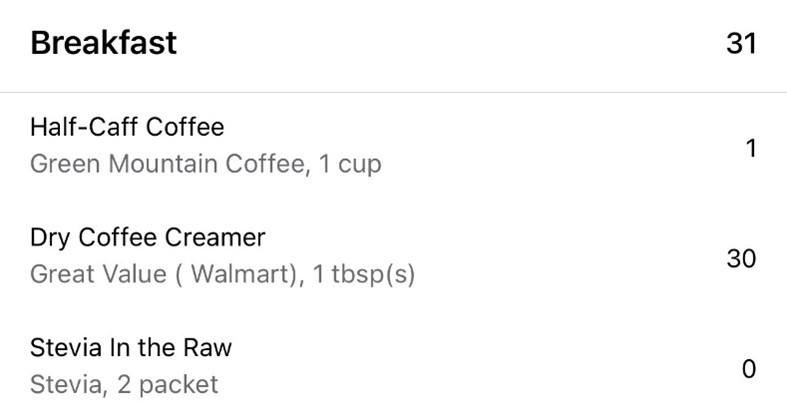
- Track everything. Don’t assume some of the “little things” don’t count. I recently realized I hadn’t been tracking my coffee in the morning. To me a couple cups of coffee with some dry non-dairy creamer and Splenda wasn’t worth tracking, but when I added it up it was over 10 carbohydrates that I was eating and not tracking every single day. If you have 3 or 4 things every day that you think aren’t a big deal, together they can still add up to make a huge difference to your overall numbers, therefore negatively affecting your results. A big one here that people don’t think of are dips and cooking oils. A tablespoon of olive oil has 13.5 grams of fat. This is 25% of my daily fat intake and an additional 121.5 calories! If I cook chicken or broccoli in olive oil and don’t count the oil, I would be unknowingly exceeding my daily fats and calories by a significant amount. A big one we have recently discovered is fucking Chick-fil-a sauce. A single 1oz serving of that packet-o’-crack is over 140 calories, including 6 grams of carbs, and 13 grams of fat!!! No wonder it is so GD delicious. I am not saying don’t eat it. Eat it if you think it’s worth it, but track it if you want your macros to be accurate.
- Have some go-to filler type foods for each type of macro. Many times, I have found myself at the end of the day having hit my max for fats and carbs for the day but low on protein. Or maybe I have hit my protein and fat for the day but am way short on carbs. Sometimes it can be hard to find foods that are high in the one macro you need more of, but that won’t send you over on your other macros. If you have some go-to staples in your pantry that you know you can turn to when needed, it makes it much easier to fill those gaps. My go-to protein add-in is protein powder. I use the Gold Standard Whey protein and normally end up having at least one a day to hit my protein goals. A good one for carbs is fruit. Fruit has a ton of carbs and pretty much no protein or fat. For fat, oil or butter is a good one. If you are low on fat, then add some olive oil to the chicken you’re cooking for dinner or some butter to your rice.
So, how do I calculate the macros that are right for me?
As I mentioned, everyone may have a different breakdown of macros based on their gender, body type, and goals. Typically, a general guideline is for protein to be between 10% to 35% of your daily calorie intake, carbs to be between 45% to 65% of your daily calorie intake, and fat to be between 20% to 35% of your daily calorie intake. A simple Google search will bring up plenty of free tools to help you calculate your own macros based on personal factors and goals. The link below is the calculator that I used, provided to me by my now coaching group, DLDNation. Feel free to use this!
***Speaking of DLDNation – wanted to give a quick shoutout to @bigwithbiebs for all the guidance she’s provided and highly recommend others reaching out to her as well. She’s currently running a special right now where new clients get one month of coaching for free when they sign-up! Learn more about Holly here***
To sum things up, everyone has their own process that will work for them. Counting macros is what has worked for me. I have no professional experience or education in nutritional science, and I can only talk to my own experience. For me, this feels like something I can do for the rest of my life, not something that I have to use will power to stick to for a few months before I reach X goal. I will continue to track macros even after I have reached my weight loss goals just to ensure I am getting the right amounts of the right types of foods that my body needs every day. I hope you got something out of this post. If you have any questions about my experience with calculating and counting my macros, feel free to reach out – I am an open book!
**Subscribe below to receive my Wellness Plan Daily Checklist to help you WIN the day, every day!
 Shimmer & Shame
Leave a comment